Explained from scratch
The primes that can never appear
Certain whole numbers have a strange self-referential property. It turns out that entire families of prime numbers are locked out of that club forever — and one line of arithmetic says which.
1 The question
Suppose you have a rule that turns a whole number into another whole number, and you ask which numbers happen to divide the result of applying the rule to themselves — not exactly, but through their prime ingredients. That is a self-referential condition, and there is no obvious reason it should behave in any orderly way.
The question here is narrower and sharper. Can a prime number be excluded from that club entirely? Not rare, not hard to find — impossible, for every number, forever.
The answer is yes, and the primes it happens to form neat families: for one rule it is every prime that leaves remainder 3 when divided by 4; for another, every prime that leaves remainder 2 when divided by 3.
2 The words you need
- Prime
- A number bigger than 1 divisible only by 1 and itself: 2, 3, 5, 7, 11, 13… Every whole number is a product of primes in exactly one way.
- Radical
- Take a number, list the different primes in it, multiply them. For
60 = 2×2×3×5 the different primes are 2, 3 and 5, so the radical
is 30. Written
rad(n). - Divides
- «a divides b» means b is a whole number of copies of a. 7 divides 28; 7 does not divide 30.
- Remainder
- What is left after dividing. 11 divided by 4 leaves remainder 3. Two numbers with the same remainder are said to be congruent.
- Multiplicative order
- Keep multiplying a number by itself, and each time keep only the remainder after dividing by a prime p. Eventually you come back to 1. How many steps that takes is the order. Example: powers of 3 with remainders mod 7 go 3, 2, 6, 4, 5, 1 — six steps, so the order is 6.
3 The recipe
Pick a rule f. The oldest is «add up all the divisors»;
the one used most here is «take the prime power and add one», so
3³ becomes 27+1 = 28.
The club. A number n belongs when
rad(n) divides f(n).
Now the observation that turns this into something you can draw. A prime divides a product only if it divides one of the pieces. So instead of one big multiplication, ask for each prime in your number: is there another prime whose piece is divisible by it? Draw a dot per prime, and an arrow from q to p when the piece contributed by q is divisible by p.
Your number is in the club exactly when every dot has at least one arrow pointing at it. Nobody vouches for themselves; one arrow in is enough.
4 Try it yourself
Take the three primes 3, 7 and 11, and the rule «add one». Choose the exponents 3, 5 and 1, so the number is 4991679 = 3³ · 7⁵ · 11. Work out the three pieces:
7⁵ + 1 = 16808 = 2³ · 11 · 191 → the piece from 7 is divisible by 11
11 + 1 = 12 = 2² · 3 → the piece from 11 is divisible by 3
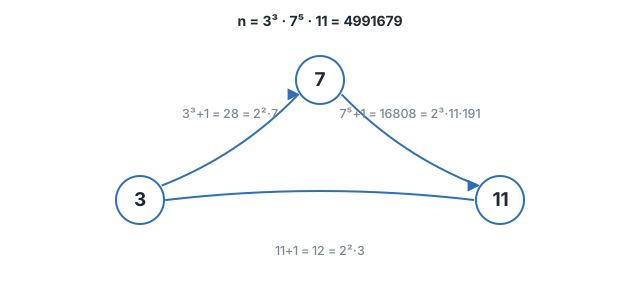
Now try to do it with only two of those primes. You cannot, and not for lack of trying: each of the three pairs fails, always for the same reason.
order of 3 mod 11 = 5 (odd) → 3 can never vouch for 11
order of 11 mod 7 = 3 (odd) → 11 can never vouch for 7
5 Where the question came from
An earlier piece of this work computed how often pairs of primes can be covered, and got an exact fraction, 31/72. It also proved something rigid: for two primes that both leave remainder 3 when divided by 4, it is never possible. The reason is a theorem Gauss proved in 1801, quadratic reciprocity: for such a pair, exactly one of the two possible arrows can exist, so one dot always goes unvouched.
That left an obvious question hanging, and nobody had answered it: what happens with three?
6 What was found
Three can do what two cannot — exactly a quarter of the time
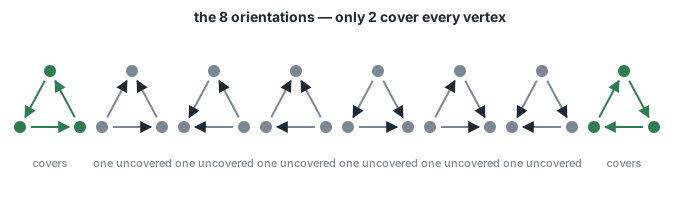
With three such primes, each pair still contributes exactly one arrow, so you get a triangle with three arrows. There are eight ways to orient it. In six, somebody is left with no arrow pointing at them. In the other two — the ones that go round in a circle — everybody is covered.
Some primes can never be pointed at
Whether an arrow into p can exist depends on the order, and the order always divides p − 1. For some rules, an arrow into p needs that order to be divisible by a fixed number m. Put the two together:
If m does not divide p − 1, then no order can be divisible by m, so no arrow can ever point at p — from any prime, inside any number, ever. That prime divides no member of the club at all.
For the rule q2e+1, that locks out every prime leaving
remainder 3 when divided by 4. And here it is in one line: an arrow into 3 would
need q2e to leave remainder 2 when divided by 3 —
but q2e is a square, and squares leave only remainder 0 or
1. Impossible, forever.
Among the first 429 odd primes, 218 are locked out for that rule, and they are exactly the ones leaving remainder 3 when divided by 4 — not most of them, all of them.
More primes is not always easier
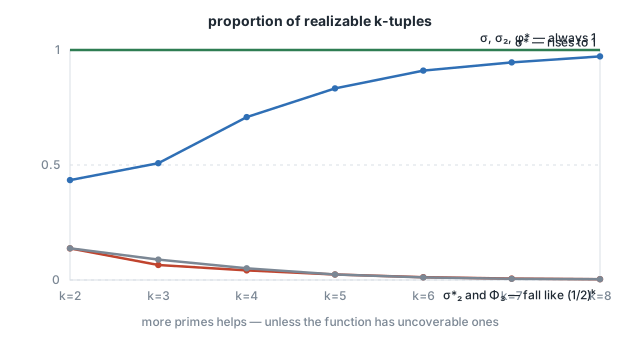
You would expect that adding primes makes covering easier: more dots, more possible arrows. For rules with no locked-out primes that is right — and in fact every set of primes works, because you can always arrange them in a circle. But if a rule has locked-out primes, each extra prime is another chance to draw one, and the proportion falls instead.
7 How it was checked
Every claim was tested twice, by methods that share no reasoning. The fast
criterion was checked against a slow brute-force search that simply computes
f(qe) as an ordinary integer and looks at its factors.
Over thousands of cases the two never disagreed — except once, which is how
a genuine mistake was found: for one rule the general description fails at the
single prime 3, and 30 disagreements pointed straight at it.
The locked-out primes were checked directly on every whole number up to three million. Of the 379 members of that club, exactly 0 have a forbidden factor.
Why a zero is not evidence on its own. A search that finds nothing proves nothing until you show it would have found something. So the same search was run on a third rule, one with no locked-out primes. It found 578. The machinery works; the zeros are real.
And the last check in the code is deliberately not about these results at all: it reproduces a density computed by Helmut Hasse in 1966. If the machinery agrees with a sixty-year-old published theorem, there is a reason to trust it on the parts that are new.
8 What it is good for
Two things, both practical for anyone working on these objects.
First, it makes searches finite where they were open-ended. If you are hunting for members of one of these clubs, you can now discard half the primes before starting, and know you have lost nothing.
Second, it settles a question that looked like it needed measurement. Whether «more primes helps» is not something to be estimated by sampling: it can be read off the rule in advance, from whether any arrow is forbidden. That turns an empirical question into a one-line check.
9 What it does not claim
- One of the four results is identified, not proved. The exact proportion of triples that work for one rule is 15590837/30623040. What is proved is that the answer lies inside an interval narrower than a millionth of a millionth of a millionth; what is identified is the simplest fraction inside it, which lands there by chance with probability about five in ten million. Very strong evidence, not a proof, and the technical write-up says exactly that.
- The proportions rest on a model of how orders are distributed. Reciprocity is built into it and matters — taking it out changes the answer by six standard errors — but the remaining assumptions are tested, not proved.
- An error of our own was found and corrected in public. An earlier comparison used a measure of statistical error twelve times too small, because it treated triples of primes as independent when they share primes. The conclusion survived; the argument for it did not, and the corrected version is what is published.
- A club being easy to join in principle does not make its members small. Half of all triples can be covered, but the smallest number that does it has, typically, about two thousand three hundred digits.
10 Glossary
- Covering digraph
- The picture of dots and arrows described in section 3. Membership of the club is exactly «every dot has an incoming arrow».
- Realizable
- A set of primes is realizable if some choice of exponents makes the resulting number a member. The primes 3, 7, 11 are realizable; the pair 3, 7 is not.
- Uncoverable prime
- A prime that no arrow can ever point at, so it divides no member at all.
- Quadratic reciprocity
- Gauss's theorem relating «is p a square modulo q?» to «is q a square modulo p?». It is what forces the rigidity between pairs of primes leaving remainder 3.
- Unitary divisor
- A divisor d of n that shares no prime with n/d.
Adding them up gives the rule
qe+1on prime powers.
11 Where to read more
Level 1 — if you liked this and want more, without formulas
- Marcus du Sautoy, The Music of the Primes (2003). Why primes are irregular and why that irregularity has structure. No formulas.
- Numberphile's videos on modular arithmetic and quadratic residues. The idea of «keeping only the remainder», which is the one thing you need for section 6.
Level 2 — a textbook, to study it properly
- G. H. Hardy and E. M. Wright, An Introduction to the Theory of Numbers, 6th ed. Chapters on multiplicative functions and on quadratic reciprocity cover everything used here.
- Kenneth Ireland and Michael Rosen, A Classical Introduction to Modern
Number Theory.
For orders, primitive roots and cyclotomic polynomials —
the machinery behind the rule
q2e+qe+1.
Level 3 — the work this one is measured against
- H. Hasse, «Über die Dichte der Primzahlen p…»,
Mathematische Annalen 166 (1966).
The density 17/24 reproduced as an external control in
verify.py. Cited as Hasse's, not claimed. - Tomohiro Yamada, «On a problem of De Koninck», arXiv:1906.10001. Uses a directed multigraph with indegree conditions, for a different equation. The graph framing is therefore not new here.
- The technical write-up: RESULT.md, and what was searched: PRIOR_ART.md.