Explained from scratch · no background needed
The numbers that draw a cycle
What the girth of a number is, where the nineteen values in this work came from, how they were checked and what they are good for. If you can divide and you remember what a prime number is, that is enough.
1The question, in plain words
We are going to draw a picture out of a number. It sounds odd, but it is simple: the dots of the picture are its primes, and the arrows come out of one calculation.
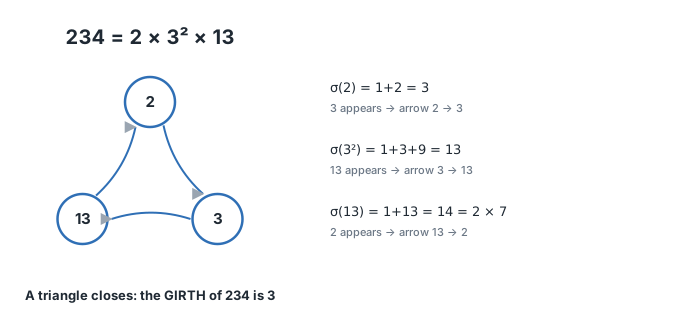
Take 234. First break it into primes:
234 = 2 × 3² × 13. The dots will be 2, 3 and 13.
Now, for each prime, compute the sum of the divisors of its power. It is schoolbook arithmetic:
And the rule for the arrows is: from each prime, draw an arrow to every
prime appearing in its result. From 2 an arrow goes to 3, because 3 showed
up. From 3, one to 13. And from 13, one back to 2, because
14 = 2 × 7 has a 2 in it.
The three arrows close a triangle: 2 → 3 → 13 → 2. A path that
returns to where it started is called a cycle, and here its length is 3.
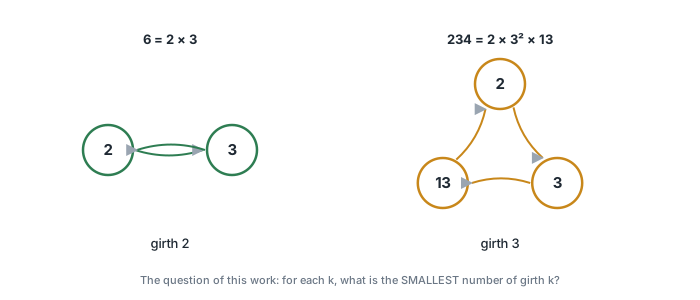
The length of the shortest cycle in a picture is called its girth.
The question of this work: for each length
k, what is the smallest number of all whose picture has a
cycle of length k?
For k = 3 the answer is 234: no smaller number has a
triangle. This work answers that question in
69 cases, using fifteen different
calculations in place of the sum of divisors.
2The words you need
- Divides
- "3 divides 12" means
12 ÷ 3comes out exact, no remainder. Written3 | 12. - Prime number
- Divisible only by 1 and by itself: 2, 3, 5, 7, 11, 13…
- Factoring
- Breaking a number into a product of primes:
234 = 2 × 3² × 13. Every number breaks up in exactly one way. - σ(n), the sum of divisors
- Add up every number that divides
n, itself included.σ(6) = 1+2+3+6 = 12. It is one of the oldest calculations in mathematics: perfect numbers are defined with it. - rad(n), the radical
- The product of the distinct primes of
n, without repeats.rad(234) = 2 × 3 × 13 = 78. - Cycle and girth
- A cycle is a path of arrows returning to where it began. The girth is the length of the shortest cycle in the picture. The word is borrowed from graph theory, the branch that studies dots joined by lines.
3How the drawing is made
One detail matters: the picture only makes sense when every prime has at least one arrow arriving at it. The numbers where that happens are called, for the sum of divisors, prime-abundant, and they are not an invention of this work: Pollack and Pomerance studied them in 2012 and they are catalogued in the OEIS encyclopedia. What is computed here is a property of the drawing of those numbers, which is a different thing.
4Try it yourself before reading on
Draw 6. Hint: 6 = 2 × 3, so there are two dots. Compute
σ(2) and σ(3) and see which primes appear.
Answer: σ(2) = 3, so an arrow 2 → 3. And
σ(3) = 1+3 = 4 = 2², so an arrow 3 → 2. The two
arrows close a cycle of length 2: the girth of 6 is 2. And no smaller
number closes at all, so 6 is the answer for k = 2.
5Where the data comes from
Nobody gave an opinion here. Each of the nineteen numbers came out of a program, and there are two different programs that share no method:
- Sieving. Walk the numbers one by one from the start, draw each one's graph, and keep the first with the girth you want. Slow, but nothing escapes it, and it works as far as the machine holds out.
- Constructing. Build candidates directly out of cycles of primes, without walking through the numbers in between. Very fast and reaches much further, but a constructed candidate is not an answer until it is measured separately.
- And crossing them. Where both reach, both must agree. That is where you find out if one of them is wrong.
In an earlier version the constructor proposed n = 120 as the
smallest of girth 3 — and the real girth of 120 is 2. Constructing is not
verifying: every candidate produced by a method has to be checked by an
independent measurement.
6What we found
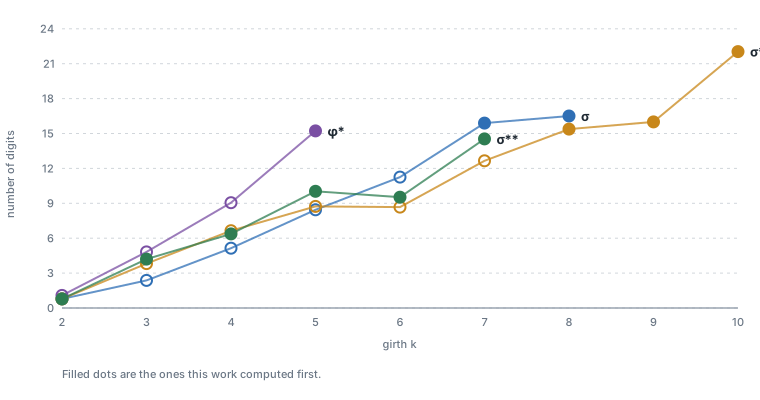
a) The twenty-six values
For four different calculations — the sum of divisors and three relatives of it — and for each girth, the smallest number. 55 of them had never been computed before.
b) From "the smallest we found" to "the smallest"
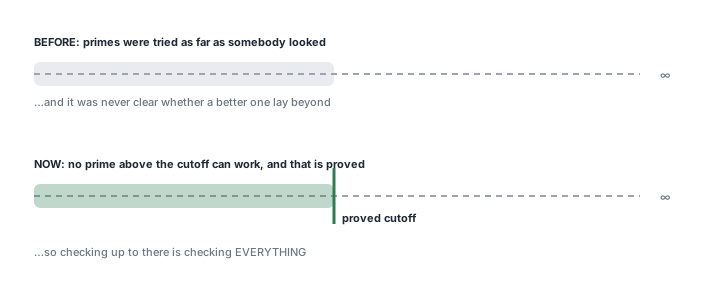
This is what turns a list into a result. The previous version of this work said, honestly, that its values were "minimal among the primes examined" — meaning that if somebody looked further, a better one might appear. That is a conjecture, not a theorem.
What closes that door is a short argument. If a number is the smallest of its girth, its largest prime cannot be arbitrary: the prime pointing at it on the cycle must contribute a value containing it, and that forces the whole number to be at least as large as a certain product. Given any already known example, that bounds the largest possible prime. And checking every prime below a bound is checking all of them.
c) And starting without knowing any answer
The cutoff above has a catch: it is stated in terms of an example already known. If nobody ever exhibited a number of some girth, there is nothing to start from, and the previous version said exactly that — that there the search was "still a heuristic search".
That turned out to be false, and the interesting part is that the previous version already had the material to notice. By doubling a bound and searching exhaustively below it, the search needs no seed at all. That produced the first value that could not have been computed before: girth 9 for one of the three functions, which had no known example of its kind.
d) Sometimes the next number is smaller, and now we can tell in advance
You would expect that asking for a longer cycle costs more, and it usually does. But twice in the table the number of the next girth is smaller than the one before. Why?
Look at the picture as a ring of beads. To make the ring one bead longer you slip a new bead in between two old ones. The new bead costs something — it is a new prime — but the bead it now sits behind may get cheaper, because it no longer has to reach all the way to the next one; a shorter reach means a smaller power. If the saving beats the cost, the longer ring is the cheaper one.
That is the whole idea, and it can be checked without finding the next number at all. Everything the check needs is in the ring you already have: for each join, the powers below the one already there, and the primes that divide the value at that power. Both lists are short and finite. If one insertion comes out cheaper than what it replaces, then the next number is smaller — proved, without searching for it.
It works: over every pair of consecutive girths in the table, the check says "smaller" exactly twice, which is exactly the two times it happens — and in both it hands you the next number itself, on the nose.
There is a bonus, and it is how two of the new values were computed. Even when the insertion is not cheaper, it still hands you a real number of the next girth — and a number in hand is exactly what the search of section 6b needs to start, which saves it all the guessing. It was run both ways to see how much that is worth: starting from nothing took 1125 seconds, starting from the number the insertion hands you took 252. It buys speed, not possibility: the search gets there either way.
7How do we know we did not get it wrong?
Because anyone can run one command and watch. The repository ships a program running 474 checks in about a minute, with nothing to install.
- Every number, from its definition. We do not check that the program agrees with itself: the radical, the divisor sum and the girth of each of the nineteen values are recomputed from scratch.
- An external control. The program counts, with its own sieve, how many numbers of this family there are up to a billion, and compares it against the count published by Pollack and Pomerance in 2012. It gives 5327 against 5328, and the difference is explained: they also count the number 1. Matching somebody else's number digit for digit is what turns "trust me" into "check it yourself".
- The numbers on this very page are tagged in the file and compared against the data. If a value improves tomorrow and this explanation is not updated, the check fails.
8What is it good for?
- It turns an infinite search into a finite one. That is the heart of it: going from "I looked this far and found nothing better" to "I proved there is nothing beyond". It is the difference between a datum and a theorem, and it shows up in any discipline that looks for the minimum of something.
- It joins two worlds usually studied apart: divisor arithmetic, two thousand years old, and graphs, three hundred. The drawing in section 1 is a bridge between them.
- It leaves open questions, written down in the repository. A result that opens none is usually a box ticked rather than a thread pulled.
9What this does NOT say
| It does not say | Why |
|---|---|
| That the family of numbers is new | It is not: for the sum of divisors they are the prime-abundant numbers of Pollack and Pomerance (2012), catalogued as A175200. What is new is the invariant of the drawing. |
| That there are values for every girth | The table goes as far as the computation went. Empty cells are empty cells, not zeros. |
| Anything about numbers outside this family | If some prime has no arrow arriving, the number is out and nothing is claimed about it. |
| That the method is the fastest possible | It was measured to be several times faster than the previous one, and that is all that is claimed. |
| That when the check finds no cheaper insertion, the next number is bigger | The check only works in one direction. When it finds one, the next number really is smaller. When it finds none, the next number could still be smaller for a reason that has nothing to do with this ring — that never happened in the table, but "never happened" is a measurement, not a proof. |
Glossary
| Word | What it means | Example |
|---|---|---|
| Prime | Only 1 and itself divide it | 2, 3, 5, 7 |
| Factoring | Breaking into a product of primes | 234 = 2·3²·13 |
| σ(n) | The sum of all divisors | σ(6) = 12 |
| rad(n) | The product of the distinct primes | rad(234) = 78 |
| Directed graph | Dots joined by arrows | 2 → 3 |
| Cycle | A path of arrows returning to the start | 2→3→13→2 |
| Girth | The length of the shortest cycle | girth(234) = 3 |
| Witness | A number exhibiting a given girth | 234 for k=3 |
Further reading
Level 1 — if you liked this and want more, without formulas
- Wikipedia, Prime number. The bricks of everything else.
- Wikipedia, Divisor function and Perfect number. Where σ(n) comes from and why it has been studied since antiquity.
- Wikipedia, Graph theory and Girth. The other half: dots, arrows, cycles and girth.
- OEIS Foundation, The On-Line Encyclopedia of Integer Sequences. More than 380,000 catalogued sequences. Where you find out whether a list of numbers was already known.
Level 2 — a textbook, to study it properly
- D. M. Burton, Elementary Number Theory, McGraw-Hill, 7th ed., 2010. The friendliest start; the divisibility and arithmetic-function chapters cover σ(n) and rad(n).
- G. H. Hardy and E. M. Wright, An Introduction to the Theory of Numbers, Oxford, 6th ed., 2008. The classic, and the standard reference for multiplicative functions.
- J. A. Bondy and U. S. R. Murty, Graph Theory, Springer, 2008. For the graph half: cycles, girth and directed graphs, with all the vocabulary.
Level 3 — the work this one is measured against
- P. Pollack and C. Pomerance, "Prime-perfect numbers", INTEGERS 12A (2012), paper A14. The family of numbers the drawing sits on, and the count of how many there are up to a given size. It is the verifier's external control.
- OEIS, A175200, the numbers with rad(n) | σ(n). The family, catalogued. It confirms this work did not invent it.
- OEIS, A000203 (σ) and A007947 (rad). The two functions in the definition.
And the work itself
- J. Ellena Godoy, "Smallest witnesses by girth for rad(n) | f(n)", 2026. DOI 10.5281/zenodo.22288593. The statements, the proofs, the data and the verifier.